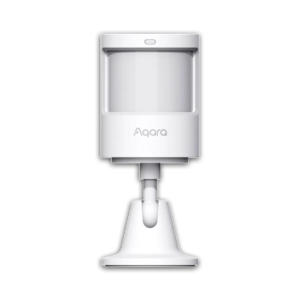
They answer different questions
A traditional motion sensor asks:
Did something move?
A presence sensor is designed to answer a more demanding question:
Is somebody still here?
That difference becomes important when automating rooms where people remain relatively still.
How PIR motion sensing works
PIR—passive infrared—sensors detect changes in infrared energy within their field of view.
They’re excellent for detecting somebody entering or walking through an area.
That makes them particularly suitable for:
- passages;
- entrances;
- stairways;
- storerooms;
- other areas characterised by obvious movement.
They can also be compact and battery efficient.
Hive’s Aqara P1 Motion Sensor is an example of this type of device.
Where motion sensing struggles
Imagine you’re working at a computer.
You entered the office, so the PIR sensor detected you.
Then you sit relatively still.
Eventually the automation may decide that no further movement means the room is empty.
The light switches off.
You wave your arms.
The light switches on.
That’s a classic case where motion detection was being asked to perform presence detection.
mmWave presence sensing
Millimetre-wave radar can detect much smaller movements than conventional PIR sensing.
That can make it better suited to rooms where people remain relatively stationary.
Examples include:
Home office — somebody working at a desk.
Living room — somebody watching television.
Bathroom — avoiding lights switching off while occupied.
Bedroom — occupancy-aware routines where appropriate.
Different mmWave products have different capabilities, however. Don’t treat all presence sensors as identical.
What about false detection?
Greater sensitivity isn’t automatically better.
Room geometry, moving objects, curtains, fans, pets, reflections and placement can affect presence-sensor behaviour depending on the technology and product.
Correct positioning and configuration matter.
A sensor that detects everything everywhere isn’t necessarily a good sensor installation.
When PIR is the better choice
If you simply need to know that somebody walked into a passage, advanced presence mapping can be unnecessary.
A good PIR sensor can be:
- simpler;
- lower power;
- battery friendly;
- entirely adequate for the automation.
Use the simplest technology that reliably solves the problem.
When presence sensing is worth it
Presence sensing becomes particularly useful when the automation needs to remain aware of people who aren’t continuously walking around.
That’s why it can transform lighting automations in offices and living spaces.
Instead of:
Motion → light on → timer → light off
you can build logic closer to:
Room occupied + insufficient daylight → light required.
Then:
Room genuinely vacant → light no longer required.
That’s a fundamentally better automation model.
PIR and mmWave together
They aren’t mutually exclusive.
Some devices combine technologies.
The Aqara FP300, for example, combines PIR with 60GHz mmWave and also incorporates ambient-light, temperature and humidity sensing. Aqara specifies Zigbee and Thread connectivity with battery operation.
Combining sensing methods can provide useful flexibility depending on the product and installation.
Which should I use by room?
Hallway/stairs: PIR motion is often enough.
Home office: presence sensing can prevent false vacancy while sitting.
Living/TV room: presence can be valuable during long periods of little movement.
Bathroom: presence can improve occupancy-based lighting.
Large room requiring zones: consider a sensor designed for spatial/zone detection such as the FP2.
Flexible wireless placement: a battery product such as the FP300 may be attractive depending on the required features.
FAQ
Is mmWave better than PIR?
Not universally. mmWave can detect finer movement, while PIR is often simpler and perfectly adequate for areas where people are moving.
Does a presence sensor detect people who aren’t moving?
mmWave can detect very small movements associated with continued occupancy, but capabilities vary by device and installation.
Which is better for Home Assistant lighting?
It depends on the room. PIR can be excellent for transient areas; presence sensing can improve rooms where occupants remain relatively still.
Do presence sensors use more power?
Technology and product design matter. Some advanced presence sensors require continuous external power, while products such as the FP300 are designed for battery operation.
Which Aqara presence sensor should I choose?
That depends on whether you prioritise zones, flexible placement, additional sensors or a dedicated powered presence role. Our FP300 vs FP2 vs FP1E guide covers exactly that.
Next steps
Compare Aqara Presence Sensors Shop Smart Sensors Explore Home Assistant