Your gate can be part of your smart home
Automated driveway gates are already normal in South Africa.
But an electric gate motor and a smart gate aren’t necessarily the same thing.
Traditional remotes give you convenient control. Smart integration can add remote operation, status information, notifications and automations involving other parts of the property.
The key is designing the system around the existing gate controller rather than treating a gate motor like an ordinary smart light.
Control and status are different
This is the most important distinction in smart gate automation.
A controller can send an open/close trigger without knowing whether the gate ultimately opened or closed.
Imagine Home Assistant sends a close command.
That tells you:
The command was sent.
It doesn’t necessarily tell you:
The gate is closed.
Reliable state-aware automation requires appropriate feedback from the gate installation.
Depending on the equipment, that may involve a position sensor, limit-state information or another suitable input.
Hive should never display “Gate Closed” merely because a close command was issued.
What can Home Assistant add?
When the appropriate controller and feedback are available, Home Assistant can bring gate information into the same system as your lighting, presence sensors and other automation.
For example:
Arrive after sunset → open gate → switch entrance lights on.
Or:
Gate remains open longer than expected → send notification.
Or:
Gate changes state while nobody is expected home → send an alert.
Those are useful because the gate becomes an input to the rest of the home rather than a standalone remote-controlled device.
Dry-contact control
Many access-control systems provide an input designed to be triggered by a dry-contact relay.
A suitable smart controller can emulate the momentary contact normally provided by a push button or other control interface.
But compatibility must be checked against the actual gate controller.
Do not assume that every gate motor expects the same wiring, voltage or trigger behaviour.
Hive gate-controller options
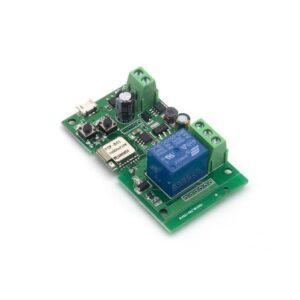
Hive currently carries products including the eWeLink Gate Controller and suitable Sonoff dry-contact equipment.
The correct product depends on:
- gate motor/controller;
- available control terminals;
- required status feedback;
- power available at the controller;
- Wi-Fi/Zigbee/network availability;
- Home Assistant integration requirement.
This is exactly why “Which smart switch should I buy for my gate?” is usually the wrong starting question.
Start with the gate controller.
Remote operation needs sensible security
Remote gate control affects physical access to the property.
That means convenience shouldn’t override security.
Use appropriate account security, protect remote-access systems, keep Home Assistant and related infrastructure maintained, and avoid exposing controllers directly to the public internet.
The existing physical safety systems of the gate must also remain functional.
Smart automation should supplement the gate controller—not bypass its safety mechanisms.
FAQ
Can Home Assistant open my driveway gate?
Potentially, when the gate controller provides an appropriate control interface and compatible smart hardware is installed.
Can Home Assistant tell whether my gate is open?
Yes, if the installation provides reliable state feedback. Sending an open/close command alone isn’t proof of gate position.
Can I keep my existing remotes?
Usually the objective is to add smart functionality while retaining normal controls, but this depends on the controller and installation.
Does smart gate control require internet?
That depends on the controller and integration route. Locally integrated equipment may provide local operation, while cloud-based services can require internet.
Can Hive help with Centurion and other gate motors?
The correct approach is to identify the exact controller/model and its available interfaces before selecting smart hardware.
Next steps
Discuss Your Gate Automation Project Shop Gate Controllers Explore Home Assistant